

Facing the dual challenges of global water shortage and low efficiency in agricultural water use, traditional irrigation models based on experience or fixed sequences are no longer sustainable. The core of precision irrigation lies in “supply on demand”, and the precise perception and efficient transmission of “demand” have become the key bottleneck. HONDE Company has deeply integrated high-precision soil moisture sensors with low-power wide-area LoRaWAN data acquisition and transmission technology to launch a new generation of intelligent irrigation Internet of Things solution. This system, with unprecedented economic efficiency, reliability and coverage capacity, transforms irrigation decisions from “guessing” to “data-driven” based on the real water conditions in the fields, providing a solid technical foundation for the digital transformation of irrigation agriculture.
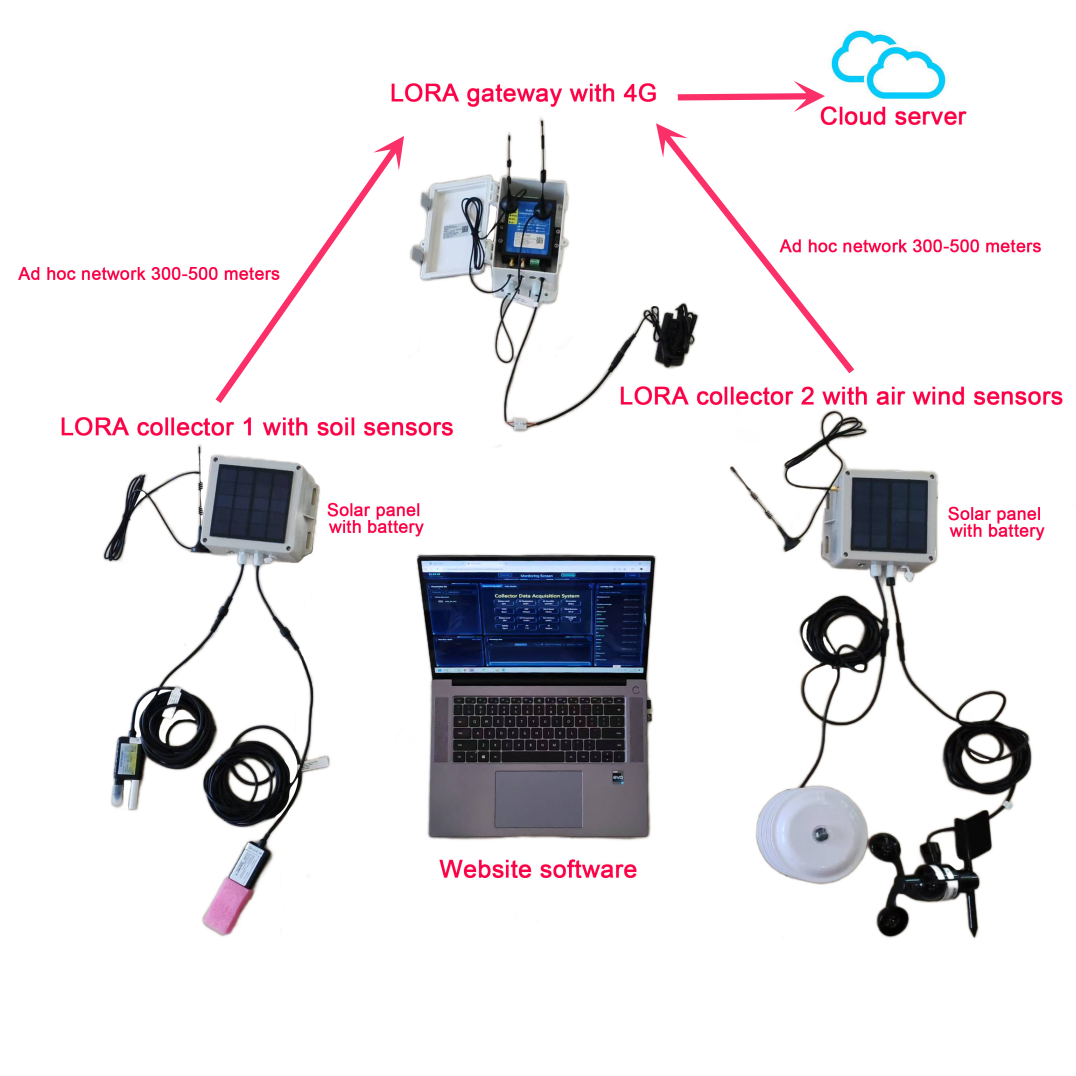
I. System Composition: A seamless link from “Soil Heartbeat” to “Cloud Decision-making”
Perception Layer: The “Water Scout” Deep into the Root System
HONDE multi-depth soil moisture sensor: Deployed in the core root layer of crops (such as 20cm, 40cm, 60cm), it accurately measures soil volumetric water content, temperature and electrical conductivity (EC). Its data directly reflects the “potable water volume” of crops and the concentration of soil solution, serving as the ultimate basis for directing irrigation.
Strategic point layout: Based on the variations in soil texture, terrain and crop planting maps of the field, grid-based or representative point layout is carried out to truly reflect the spatial distribution of water throughout the field.
Transport Layer: A vast “invisible information superhighway”
HONDE LoRa data collector: Connected to soil sensors, it is responsible for data collection, packaging and wireless transmission. Its ultra-low power consumption feature, combined with small solar power supply panels, enables continuous field operation for 3 to 5 years without maintenance.
LoRaWAN gateway: As a regional hub, it receives data sent by all collectors within a radius of 3 to 15 kilometers and uploads it to the cloud via 4G/ Ethernet. A single gateway can easily cover thousands or even tens of thousands of acres of farmland, and the cost of network deployment is extremely low.
Decision-making and execution layer: An intelligent closed loop from data to action
Cloud-based irrigation decision engine: The platform automatically calculates irrigation requirements based on real-time soil moisture data, crop types and growth stages, and meteorological evaporation demands (which can be integrated), and generates irrigation prescriptions.
Diversified control interfaces: Through API or Internet of Things protocols, it can flexibly control various irrigation equipment such as central pivot sprinkler irrigation machines, drip irrigation solenoid valves, and pumping stations, achieving precise execution in terms of timing, quantity, and zones.
Ii. Technical Advantages: Why LoRaWAN + Soil Moisture Sensor?
Ultra-long distance and powerful coverage: LoRa technology has significant communication advantages in open farmland, with a long single-hop transmission distance, perfectly solving the signal coverage problem in large areas of farmland without the need for expensive relay equipment.
Extremely low energy consumption and operation and maintenance costs: The sensor nodes are in a “sleep” state for the vast majority of the time, only waking up a few times a day to send data, enabling the solar power supply system to operate stably even in continuous rainy weather, achieving nearly “zero energy consumption” operation and “zero wiring” deployment, and significantly reducing the total cost of ownership.
High density and large capacity: The LoRaWAN network supports massive terminal access, allowing sensors to be deployed in the field at a reasonable density, thereby accurately characterating the spatial variation of soil moisture and laying the foundation for variable irrigation.
Outstanding reliability: Operating in the unlicensed Sub-GHz frequency band, it has strong anti-interference ability and good signal penetration, and can stably cope with complex environments such as canopy changes and rainfall during the crop growing season.
Iii. Core Application Scenarios and Precision Irrigation Strategies
Threshold-triggered automatic irrigation
Strategy: Set upper and lower limit thresholds for soil moisture content for different crops and at different growth stages. When the sensor detects that the moisture content is below the lower limit threshold, the system automatically issues an opening command to the irrigation valve in the corresponding area. It will automatically close when the upper limit is reached.
Value: Ensure that the moisture content in the root zone of crops is always maintained within the ideal range, avoid drought and flood stress, and achieve “on-demand water replenishment”, which can save an average of 25-40% of water.
2. Variable irrigation based on spatial variation
Strategy: By analyzing the data from the grid-arranged sensors, generate a spatial distribution map of soil moisture in the field. Based on this, the system drives irrigation equipment with variable functions (such as VRI central pivot machines) to water more in arid areas and less or no in moist areas.
Value: Significantly enhance the uniformity of water throughout the field, eliminate the yield “shortcoming” caused by uneven soil texture, achieve balanced production increase while conserving water, and improve water efficiency by more than 30%.
3. Integrated intelligent management of water and fertilizer
Strategy: Combine the data from soil EC sensors to monitor the changes in soil salinity after irrigation. During irrigation, based on the nutrient requirements of crops and the soil EC value, the proportion and timing of fertilizer injection are precisely controlled to achieve “water and fertilizer coupling”.
Value: Prevent salt damage and nutrient leaching caused by excessive fertilization, increase fertilizer utilization rate by 20-30%, and protect soil health.
4. Performance Evaluation and optimization of irrigation systems
Strategy: Continuously monitoring the dynamic changes of soil moisture at different depths before, during and after irrigation can accurately assess the infiltration depth, uniformity and irrigation efficiency of irrigation water.
Value: Diagnose problems existing in the irrigation system (such as clogged nozzles, pipe leaks, and unreasonable design), and continuously optimize the irrigation system to achieve lean management of the irrigation system itself.
Iv. Fundamental Changes Brought about by the System
From “irrigating on time” to “irrigating on demand” : The basis for decision-making changes from calendar time to the real physiological needs of crops, achieving the optimal allocation of water resources.
From “manual inspection” to “remote perception” : Managers can have a comprehensive grasp of the soil moisture conditions of all fields through mobile phones or computers, greatly reducing labor intensity and improving management efficiency.
From “uniform irrigation” to “precise variables” : Acknowledging and managing the spatial heterogeneity in the field to shift irrigation from extensive to precise is in line with the core essence of modern precision agriculture.
From the “single goal of water conservation” to the “multi-goal synergy of increased production, improved quality and environmental protection” : While ensuring the optimal water state of crops to promote increased production and improved quality, it reduces deep seepage and runoff, and lowers the risk of agricultural non-point source pollution.
V. Empirical Case: A Data-Driven Miracle of Water Conservation and Increased Production
On an 850-acre circular sprinkler farm in the Midwestern United States, managers deployed the HONDE LoRaWAN soil moisture monitoring network and linked it with the VRI system of the central pivot sprinkler. After the system was in operation for one growing season, it was found that due to uneven soil sandiness, about 30% of the field area had extremely poor water retention capacity.
Traditional model: Uniform irrigation throughout the entire area, insufficient water in arid regions, and deep water seepage in sandy areas.
Intelligent variable mode: The system commands the sprinkler to automatically reduce the water spray volume when passing through sandy areas and increase it when passing through areas with poor water holding capacity.
Outcome: Despite a 22% reduction in total irrigation water throughout the entire growth period, the average yield of corn across the field increased by 8%, as the “yield reduction points” caused by drought stress were eliminated. The direct economic benefits brought by water conservation and increased production alone enabled the full recovery of the system investment within one year.
Conclusion
The future of irrigated agriculture is bound to be a future driven by data intelligence. HONDE’s intelligent soil moisture monitoring system based on LoRaWAN, with its outstanding advantages of wide coverage, low power consumption, high reliability and easy deployment, has successfully solved the core pain points of “inaccurate measurement, inability to transmit back and inability to control precisely” in the large-scale implementation of precision irrigation. It is like weaving a “neural network” for the farmland to sense the pulse of water, enabling every drop of water to move as needed and be delivered precisely. This is not merely a technological innovation, but also a paradigm revolution in irrigation management. It marks that agricultural production has officially moved from relying on natural precipitation and extensive flooding irrigation to an era of intelligent and precise irrigation based on real-time soil data across the entire region, providing a replicable and scalable modern solution for ensuring global water and food security.
About HONDE: As an active practitioner of agricultural Internet of Things and smart water conservancy, HONDE is dedicated to integrating the most suitable communication technologies with precise agricultural sensing technologies to provide customers with end-to-end intelligent irrigation solutions from perception, transmission to decision-making and execution. We firmly believe that empowering every drop of water with data is the most effective way to achieve sustainable agricultural development.
For more soil sensor information, please contact Honde Technology Co., LTD.
WhatsApp: +86-15210548582
Email: info@hondetech.com
Company website: www.hondetechco.com
Post time: Dec-15-2025